
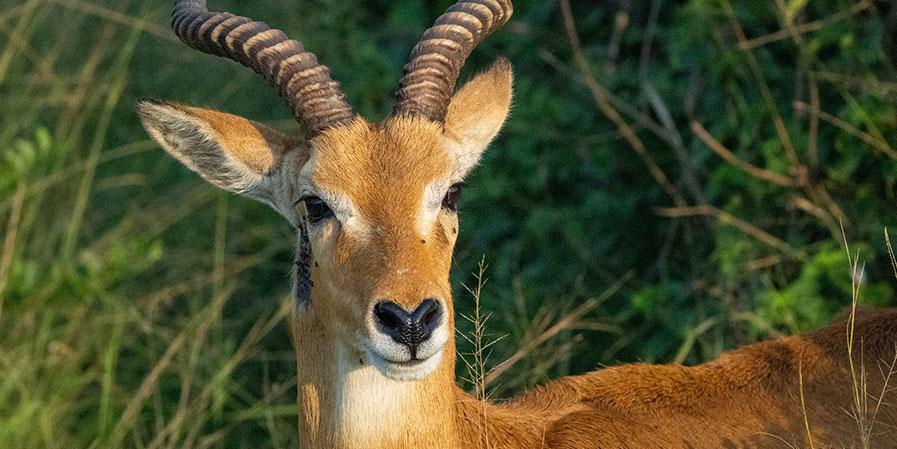
The Uganda kob (Kobus kob thomasi) is a subspecies of the kob, a type of antelope found in sub-Saharan Africa in Uganda, South Sudan, and the Democratic Republic of Congo (DRC).
Below are facts about the Uganda kob.
- Physically, they resemble an impala, and females stand between 95 and 100 centimeters.
- Males appear larger than females, hence weighing over 95 kilograms (207 lb), while females weigh about 63 kilograms (139 lb).
- Regarding naming, this is done differently depending on different tribes in Uganda.
- In Buganda it is called ‘Ensiima,’ in Acholi it is called ‘Till,’ and in Bagisu it is called ‘Ishisi. ‘
- Ugandan kobs are herbivorous and feed mostly on grass and reeds.
- In most cases non-breeding males form their own groups while females become sexually mature in their second year.
- Calving takes place at the end of the rainy season; a single calf is born in November or December, after a gestation period of about nine months.
- Male kobs hold territories of up to 200 m in diameter.
- Males defend tiny territories and mate 20+ times in a day.
- Uganda kobs have a reddish brown white patch on the throat and ears and a black front on the legs.
- The Uganda kob can live to 17 years of age.
- Uganda kob habitats are characterized by grasslands, savannas, and proximity to permanent water sources.
- Females are known to be more social than males.
- The male kobs are territorial and keep dominance over specific areas, but this can be undone by other males through ritual fighting by clashing and twisting each other’s horns.
- The gestation period of a Uganda kob takes 8-9 months before a calf is born, and breastfeeding takes place till 7 months, and after weaning, the calves start feeding on the tender green grass.
- They live in groups ranging from 4 to 50 animals, and the female always leads the line.